Bimanual LEGO Assembly
Why contact-rich bimanual manipulation is the frontier challenge,
how the field approaches it today, and our path forward
The Problem: Bimanual Manipulation
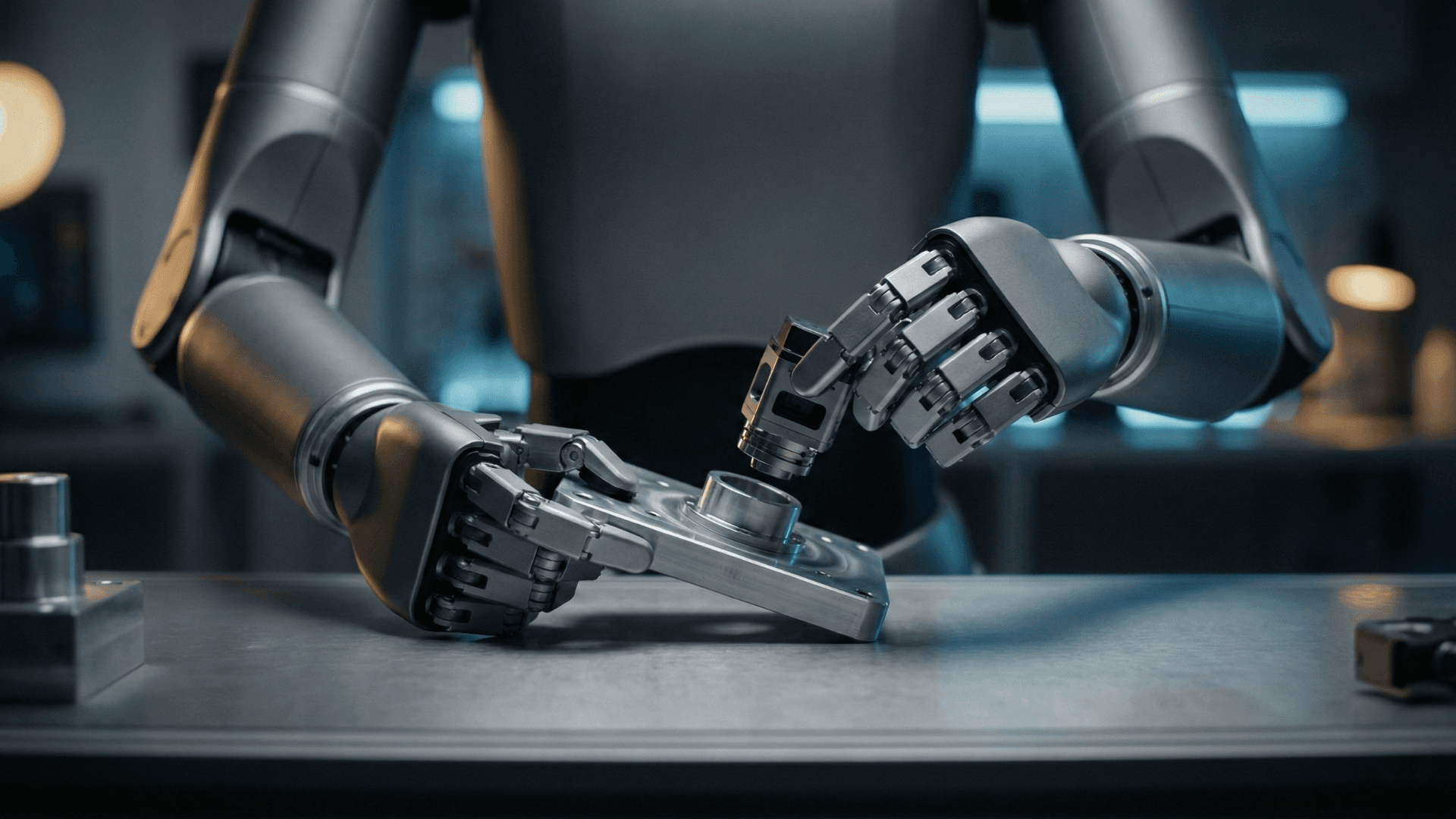
Bimanual manipulation means coordinating two robotic arms to complete one shared task, for example one arm stabilizes while the other aligns, inserts, or presses. It is essential for general-purpose robotics because humans rely on two hands for many daily activities, including assembly, cooking, folding clothes, and tool use.
Coordination & High-DoF Control
16+ DoF action space across two arms. Roles — anchor, insert, handover — must switch dynamically without self-collision.
Contact Dynamics & Uncertainty
Discontinuous snap forces and nonlinear contact profiles vary with geometry and grasp. Sim-to-real transfer amplifies every gap.
Perception Under Occlusion
Arms and structure block nearly every camera angle. Block poses and connection states must be inferred from partial observations.
Long-Horizon Sequencing
Dozens of atomic actions in structurally valid order. The policy must plan across minutes while constraints shift with each insertion.
Error Recovery
Misalignments and drops are inevitable at 0.1 mm tolerances. Detect, diagnose, and correct — without disrupting the partial assembly.
Real-Time Constraints
10–50 Hz control to handle force transients, while processing multi-view images, proprioception, and language in real time.
The Landscape
Four major paradigms have been applied to robotic manipulation. Each solves part of the bimanual assembly puzzle, but none solves it completely.
Single-Task Reinforcement Learning
Trial-and-error reward learning (PPO/SAC), usually in simulation, then sim-to-real via domain randomization.
- +Can discover bimanual strategies planners miss
- +Could work on contact-rich dynamics
- +Simulation provides near-unlimited data
- −Reward design for bimanual assembly is hard
- −New tasks usually need full retraining
- −Contact physics widens the sim-to-real gap
Imitation Learning & Diffusion Policies
Learns from expert demos; diffusion methods (Diffusion Policy, ACT) model multimodal precise actions.
- +No manual reward engineering
- +Captures multimodal contact-rich actions
- +Strong short-horizon precision control
- −Limited by demo quality and coverage
- −Weak recovery: demos rarely include corrections
- −Limited long-horizon reasoning and no planner
Vision-Language-Action Models
End-to-end foundation models: vision + language in, continuous robot actions out, one transformer.
- +Language-conditioned control from instructions
- +Cross-embodiment transfer from large pretraining
- +Interleaved reasoning can flag errors mid-execution
- −Most models target single-arm manipulation
- −Usually validated at centimeter precision
- −Bimanual coordination is still weakly validated
Modular & Hierarchical Systems
Splits manipulation into a high-level planner (LLM/task graph) and low-level skill controllers via a structured interface.
- +Interpretable decomposition with reusable skill primitives
- +High-level planners handle long-horizon reasoning well
- +Each layer can be improved independently
- −Plan-execute gap on low-level contact events
- −Errors propagate across modules and compound
- −Integration complexity grows with skills and transitions
Our Solution
We resolved the gaps identified above by combining EO-1, a SOTA VLA with interleaved reasoning and continuous action generation, with bimanual LEGO assembly as a precision-demanding benchmark, deployed on the IHMC Alex through a simulation-first pipeline.
EO-1's unified architecture processes language instructions, visual observations, and proprioceptive state in a single forward pass, interleaving reasoning tokens with continuous flow-matched actions. This eliminates the plan-execute gap that cripples modular systems, while its 16-step action chunks generate bimanual trajectories at the control frequencies contact-rich assembly demands.
LEGO assembly serves as the ideal evaluation substrate: it requires sub-millimeter precision, forces genuine bimanual coordination (one hand must always anchor), and produces objectively verifiable success metrics because every stud either connects or it does not.